
At its core, Cold Isostatic Pressing (CIP) improves production efficiency by combining automation, rapid cycle times, and the ability to produce highly uniform parts in large volumes. This process significantly reduces manual labor and creates high-integrity preforms that minimize defects and waste in subsequent manufacturing stages like sintering or machining.
The true efficiency of CIP extends beyond the pressing stage itself. By creating superior, near-net-shape parts with uniform density, it drastically reduces downstream rework, scrap rates, and finishing time, optimizing the entire production lifecycle.
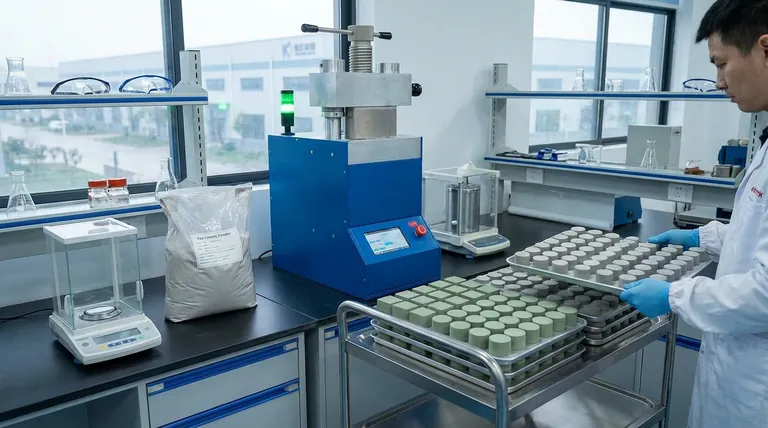
The Core Mechanisms of CIP Efficiency
Cold Isostatic Pressing streamlines production through several distinct advantages over traditional compaction methods. These mechanisms work together to increase throughput, reduce costs, and improve final part quality.
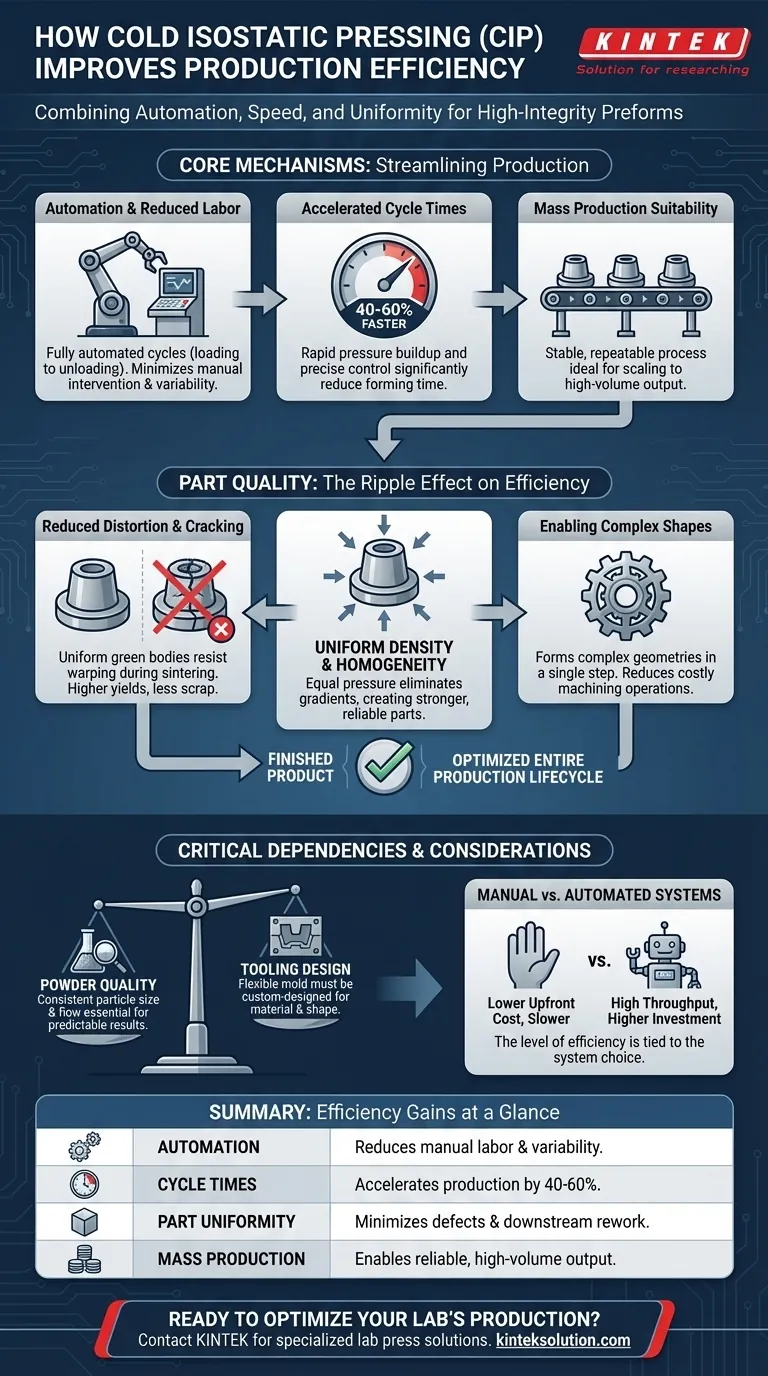
Automation and Reduced Labor
Modern electrical CIP systems automate the entire pressing cycle, from loading and pressurization to depressurization and unloading. This automation minimizes the need for manual operator intervention, which not only reduces labor costs but also eliminates a significant source of process variability and potential contamination.
Accelerated Cycle Times
Automated CIP equipment offers precise control over pressure parameters and enables rapid pressure buildup. Compared to older, manually operated CIP systems, modern automated processes can reduce forming time by 40% to 60%, directly increasing the number of parts that can be produced in a given period.
Suitability for Mass Production
The CIP process is inherently stable and repeatable. Once the parameters for a specific part and material are established, the system can reliably produce thousands of identical components. This stability makes it an ideal technology for scaling up to mass production.
How Part Quality Boosts Overall Efficiency
A key, and often overlooked, aspect of CIP's efficiency is its impact on the quality of the intermediate part, or "green body." This initial quality has a cascading effect, preventing problems and saving time throughout the rest of the manufacturing process.
Uniform Density and Homogeneity
CIP applies pressure equally from all directions, creating a solid, homogeneous mass with highly uniform density. This eliminates the density gradients and weak points common in uniaxial pressing, leading to stronger, more reliable final components.
Reduced Distortion and Cracking
Because the green bodies produced by CIP are so uniform, they experience very little distortion, warping, or cracking during the high temperatures of the subsequent sintering phase. This drastically increases the final yield and reduces the amount of scrapped material, a major source of inefficiency and cost.
Enabling Complex Shapes
CIP is capable of forming complex geometries in a single pressing step. This can eliminate the need for multiple, time-consuming, and expensive machining operations that would be required if the part were made from a simple block or rod.
Understanding the Dependencies and Trade-offs
The efficiency gains from CIP are not automatic. They are highly dependent on careful process control and upfront investment in materials and tooling.
The Critical Role of Powder Quality
The efficiency of the pressing operation is directly influenced by the quality of the raw powder. The material must have the proper particle size distribution, flowability, and tap density to ensure it fills the mold uniformly and compresses predictably. Inconsistent powder will lead to inconsistent parts and process failures.
The Impact of Tooling Design
The flexible mold or "bag" used in CIP is a critical piece of tooling. Its design must be tailored to the specific powder being used and the final desired shape. A poorly designed tool will fail to produce accurate parts, leading to waste and process downtime.
Manual vs. Automated Systems
While all CIP provides benefits, the level of efficiency is tied to the system. Manual CIP is less expensive upfront but is far more labor-intensive and slower. Fully automated electrical CIP systems deliver the highest throughput and consistency but require a larger capital investment.
Making the Right Choice for Your Application
To effectively leverage Cold Isostatic Pressing, align your implementation strategy with your primary production goal.
- If your primary focus is maximizing throughput: Invest in a fully automated electrical CIP system to take advantage of its rapid, repeatable cycle times and minimal labor requirements.
- If your primary focus is producing high-integrity, complex parts: Prioritize rigorous control over your powder quality and partner with experts to develop precision tooling to minimize downstream failures.
- If your primary focus is process stability: CIP provides an exceptionally stable forming method, but remember that this stability is dependent on the consistency of your input materials.
By viewing CIP as an integrated part of your workflow, you can unlock efficiency gains that extend far beyond the press itself.
Summary Table:
| Efficiency Factor | Key Benefit |
|---|---|
| Automation | Reduces manual labor and variability |
| Cycle Times | Accelerates production by 40-60% |
| Part Uniformity | Minimizes defects and downstream rework |
| Mass Production | Enables reliable, high-volume output |
Ready to optimize your lab's production with Cold Isostatic Pressing? KINTEK specializes in lab press machines, including automatic lab presses, isostatic presses, and heated lab presses, designed to enhance efficiency, reduce costs, and ensure high-quality results for your laboratory needs. Contact us today to discuss how our solutions can transform your workflow!
시각적 가이드
관련 제품
- 전기 실험실 냉간 등방성 프레스 CIP 기계
- 전기 분할 실험실 냉간 등방성 프레스 CIP 기계
- 자동 실험실 냉간 등방성 프레스 CIP 기계
- 수동 냉간 등방성 프레스 CIP 기계 펠릿 프레스
- 등방성 성형을 위한 실험실 등방성 프레스 금형
















