지식 How does using a hydraulic hot press at different temperatures affect the final microstructure of a PVDF film? Achieve Perfect Porosity or Density
작성자 아바타

기술팀 · Kintek Press

업데이트됨 1 hour ago

How does using a hydraulic hot press at different temperatures affect the final microstructure of a PVDF film? Achieve Perfect Porosity or Density


Temperature is the decisive factor in determining the final microstructure of a PVDF film during hydraulic hot pressing.

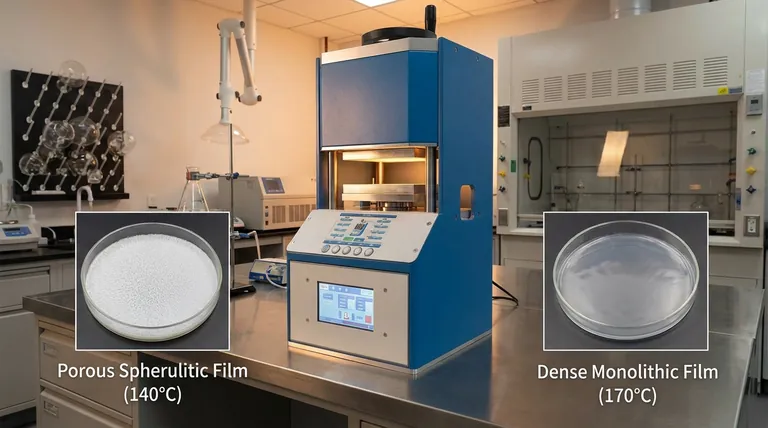
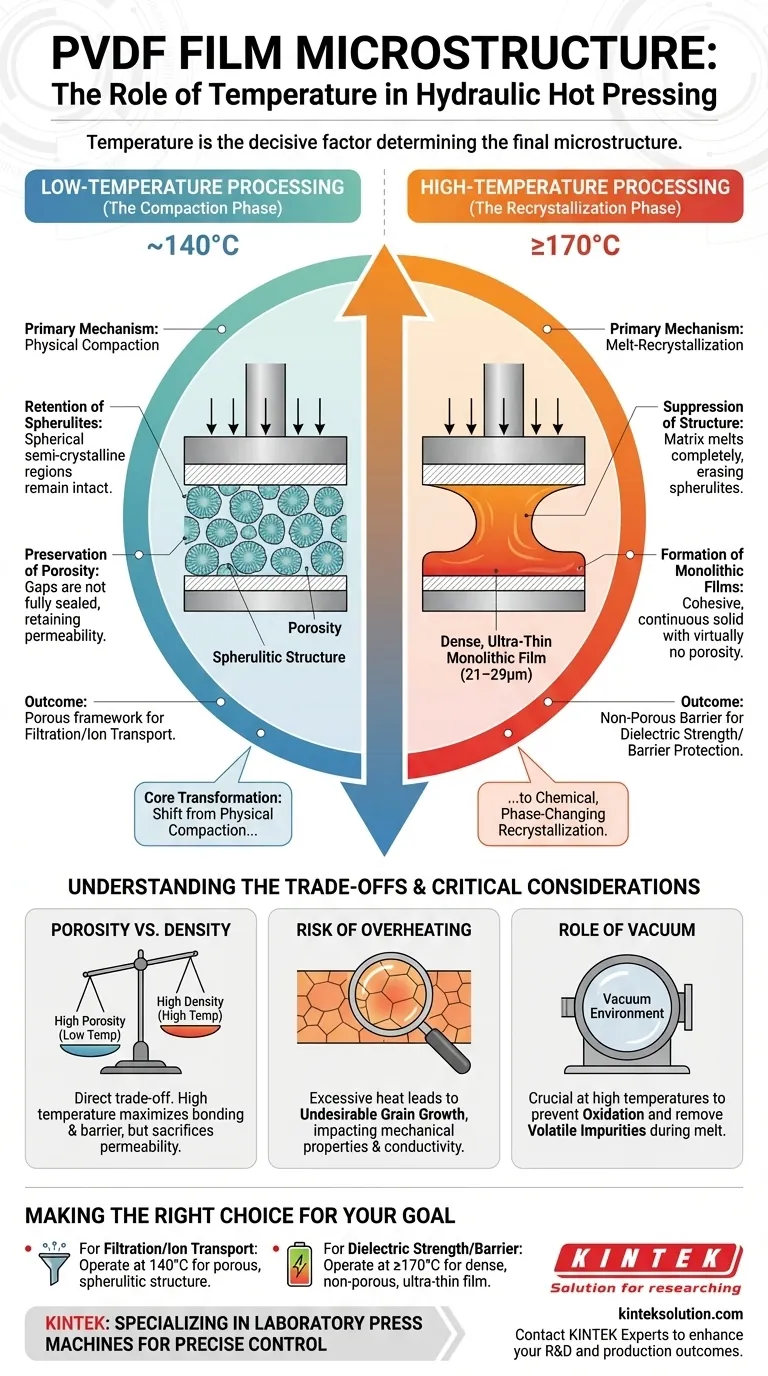
At lower temperatures (around 140°C), the process acts as a compaction mechanism, preserving the original spherulitic structure and retaining porosity. Conversely, raising the temperature to 170°C or above triggers a melt-recrystallization process, effectively erasing the spherulitic structure to create a dense, ultra-thin, monolithic film.

The Core Transformation The transition from 140°C to 170°C represents a shift from physical compaction to chemical, phase-changing recrystallization. You are effectively choosing between a porous, structured membrane and a dense, non-porous barrier by crossing this thermal threshold.

Low-Temperature Processing (The Compaction Phase)

When operating the hydraulic hot press at lower temperatures, specifically around 140°C, you are primarily affecting the physical arrangement of the material rather than its chemical phase.

Retention of Spherulites

At this temperature, the thermal energy is insufficient to fully melt the PVDF matrix. Consequently, the original spherulitic structure—the spherical semi-crystalline regions—remains intact.

Preservation of Porosity

Because the material does not undergo a complete melt flow, the gaps between structures are not fully sealed. The pressing action compacts the film to increase density, but it deliberately allows a degree of porosity to remain.

Mechanical Bonding

The pressure facilitates contact between particles, enhancing bonding strength. However, this bonding relies on physical proximity and partial diffusion rather than a total coalescence of the melt.

High-Temperature Processing (The Recrystallization Phase)

Increasing the temperature to 170°C and above fundamentally alters the processing mechanism from compaction to melting.

Suppression of Structure

At these elevated temperatures, the PVDF matrix melts completely. This phase change suppresses the formation of the spherulitic structure that characterizes lower-temperature films.

Formation of Monolithic Films

As the material recrystallizes from the melt, it forms a cohesive, continuous solid. The result is a dense, monolithic film with virtually no porosity, as the molten polymer fills all available voids.

Drastic Reduction in Thickness

The transition to a melt state allows the hydraulic pressure to compress the material much more efficiently. This results in an ultra-thin profile, typically reducing the film thickness to the 21–29µm range.

Understanding the Trade-offs

While hot pressing offers precise control over microstructure, grain size, and distribution, selecting the wrong temperature can compromise the material's intended function.

Porosity vs. Density

There is a direct trade-off between porosity and density. High temperatures maximize atomic diffusion and bonding strength, creating a robust barrier, but this comes at the cost of the porosity required for applications like filtration or ion transport.

The Risk of Overheating

While higher temperatures generally improve bonding, excessive heat can lead to undesirable grain growth. This can negatively impact mechanical properties, making the material brittle or altering its thermal and electrical conductivity in unintended ways.

The Role of Vacuum

It is critical to note that high-temperature processing is best conducted in a vacuum environment. This prevents oxidation that would otherwise weaken the material at these heat levels and ensures volatile impurities are removed during the melt phase.

Making the Right Choice for Your Goal

The correct temperature setting depends entirely on whether your application requires a permeable framework or a solid, thin dielectric layer.

  • If your primary focus is filtration or ion transport: Operate at 140°C to compact the film while retaining the porous, spherulitic structure necessary for permeability.
  • If your primary focus is high dielectric strength or barrier protection: Operate at 170°C or above to melt the matrix, creating a dense, ultra-thin, and non-porous monolithic film.

By manipulating the temperature relative to the PVDF melting point, you move from simply shaping the material to fundamentally engineering its internal architecture.

Summary Table:

Temperature Primary Mechanism Final Microstructure Key Outcome
~140°C Physical Compaction Porous, Spherulitic Structure Retained Porosity for Filtration/Ion Transport
≥170°C Melt-Recrystallization Dense, Monolithic Film Ultra-Thin, Non-Porous Barrier for Dielectric Strength

Ready to Engineer Your PVDF Film's Microstructure with Precision?

Choosing the right hydraulic hot press temperature is critical for achieving your desired film properties, whether for filtration, battery separators, or high-performance dielectric layers. KINTEK specializes in laboratory press machines, including automatic lab presses, isostatic presses, and heated lab presses designed for exact temperature and pressure control.

Our equipment helps researchers and lab professionals like you consistently produce high-quality PVDF films with tailored porosity and density. Contact us today via the form below to discuss your specific application and discover how our reliable lab presses can enhance your R&D and production outcomes.

Contact KINTEK Experts Now

관련 제품

사람들이 자주 묻는 질문

관련 제품

실험실용 가열판이 있는 자동 고온 가열 유압 프레스 기계

실험실용 가열판이 있는 자동 고온 가열 유압 프레스 기계

킨텍 고온 핫 프레스: 실험실을 위한 정밀 소결 및 재료 가공. 극한의 온도와 일관된 결과를 달성하세요. 맞춤형 솔루션 제공.

실험실용 가열 플레이트가 있는 자동 가열 유압 프레스 기계

실험실용 가열 플레이트가 있는 자동 가열 유압 프레스 기계

킨텍 자동 가열식 유압 실험실 프레스: 정밀 가열, 균일한 압력, 자동 제어로 탁월한 시료 처리가 가능합니다. 실험실 및 연구에 이상적입니다. 지금 바로 문의하세요!

핫 플레이트 유압 프레스 기계가 통합된 수동 가열식 유압 실험실 프레스

핫 플레이트 유압 프레스 기계가 통합된 수동 가열식 유압 실험실 프레스

킨텍의 정밀 실험실 프레스는 재료 연구, 약학 및 세라믹을 위한 효율적인 고온 시료 전처리를 제공합니다. 지금 모델을 살펴보세요!

핫 플레이트가 있는 실험실 분할 수동 가열 유압 프레스 기계

핫 플레이트가 있는 실험실 분할 수동 가열 유압 프레스 기계

정밀한 온도 제어, 내구성 있는 디자인, 빠른 냉각으로 일관된 결과를 제공하는 킨텍의 가열식 실험실 프레스로 실험실 효율성을 높이세요. 지금 살펴보세요!

실험실용 핫 플레이트가 있는 자동 가열식 유압 프레스 기계

실험실용 핫 플레이트가 있는 자동 가열식 유압 프레스 기계

킨텍 자동 실험실 가열 프레스: 정밀 가열, 프로그래밍 가능한 제어, 빠른 냉각으로 효율적인 시료 전처리. 지금 바로 실험실 생산성을 향상하세요!

핫 플레이트가 있는 실험실 수동 가열식 유압 프레스 기계

핫 플레이트가 있는 실험실 수동 가열식 유압 프레스 기계

킨텍의 수동 핫 프레스는 열과 압력을 제어하여 정밀한 재료 가공을 제공합니다. 신뢰할 수 있는 접착과 고품질 샘플이 필요한 실험실에 이상적입니다. 지금 바로 문의하세요!

실험실용 핫 플레이트가있는 24T 30T 60T 가열 유압 실험실 프레스 기계

실험실용 핫 플레이트가있는 24T 30T 60T 가열 유압 실험실 프레스 기계

정밀한 시료 전처리를 위한 고품질 유압식 실험실 프레스. 재료 연구, 약국 등을 위한 자동 또는 가열식 모델을 선택하세요. 지금 견적을 받아보세요!

열판이 있는 분할 자동 가열식 유압 프레스 기계

열판이 있는 분할 자동 가열식 유압 프레스 기계

킨텍 분할 자동 가열 실험실 프레스: 효율적인 시료 준비를 위한 300°C 가열 기능을 갖춘 정밀 유압 프레스. 연구실에 이상적입니다.

진공 박스 실험실 핫 프레스용 열판이 있는 가열식 유압 프레스 기계

진공 박스 실험실 핫 프레스용 열판이 있는 가열식 유압 프레스 기계

진공 박스가 있는 킨텍 가열식 유압 실험실 프레스는 정밀한 시료 전처리를 보장합니다. 컴팩트하고 내구성이 뛰어나며 디지털 압력 제어 기능으로 탁월한 결과를 제공합니다.

진공 박스 실험실 핫 프레스 용 열판이있는 가열식 유압 프레스 기계

진공 박스 실험실 핫 프레스 용 열판이있는 가열식 유압 프레스 기계

균일하고 산화되지 않는 시료를 위한 킨텍의 가열 진공 랩 프레스로 실험실 정밀도를 향상시키세요. 민감한 물질에 이상적입니다. 지금 전문가의 조언을 받아보세요!

수동 실험실 유압 프레스 실험실 펠렛 프레스

수동 실험실 유압 프레스 실험실 펠렛 프레스

킨텍의 보호용 수동 실험실 유압 프레스는 내구성이 뛰어난 구조, 다양한 응용 분야 및 고급 안전 기능으로 안전하고 정밀한 시료 전처리를 보장합니다. 실험실에 이상적입니다.

실험실 유압 프레스 실험실 펠렛 프레스 버튼 배터리 프레스

실험실 유압 프레스 실험실 펠렛 프레스 버튼 배터리 프레스

킨텍 실험실 프레스 기계: 재료 연구, 약학 및 전자 분야를 위한 정밀 유압 프레스. 컴팩트하고 내구성이 뛰어나며 유지보수가 간편합니다. 지금 전문가의 조언을 받아보세요!

수동 실험실 유압 펠릿 프레스 실험실 유압 프레스

수동 실험실 유압 펠릿 프레스 실험실 유압 프레스

컴팩트하고 누출 방지 기능이 있으며 분광학에 이상적인 킨텍의 정밀 유압 프레스로 실험실 효율성을 높이세요. 맞춤형 솔루션 제공.

실험실용 유압 프레스 2T 실험실 펠릿 프레스 KBR FTIR용

실험실용 유압 프레스 2T 실험실 펠릿 프레스 KBR FTIR용

정밀한 FTIR 시료 전처리, 내구성 있는 KBr 펠릿 생성 및 다양한 재료 테스트를 위한 KINTEK 2T 실험실 유압 프레스입니다. 연구실에 이상적입니다.

XRF 및 KBR 펠릿 프레스용 자동 실험실 유압 프레스

XRF 및 KBR 펠릿 프레스용 자동 실험실 유압 프레스

KinTek XRF 펠릿 프레스: 정밀한 XRF/IR 분석을 위한 자동화된 샘플 준비. 고품질 펠릿, 프로그래밍 가능한 압력, 내구성 있는 디자인. 지금 바로 실험실 효율성을 높이세요!

실험실용 원통형 실험실 전기 가열 프레스 금형

실험실용 원통형 실험실 전기 가열 프레스 금형

킨텍의 원통형 전기 가열 프레스 몰드는 실험실 샘플 준비를 위한 빠른 가열(최대 500°C), 정밀한 제어 및 맞춤형 크기를 제공합니다. 배터리, 세라믹 및 재료 연구에 이상적입니다.

실험실 열 프레스 특수 금형

실험실 열 프레스 특수 금형

안정적인 시료 전처리를 위한 정밀 KINTEK 실험실 프레스 금형. 내구성이 뛰어나고 사용자 정의가 가능하며 다양한 연구 요구에 이상적입니다. 지금 바로 실험실의 효율성을 높여보세요!

글러브 박스용 실험실 유압 프레스 실험실 펠렛 프레스 기계

글러브 박스용 실험실 유압 프레스 실험실 펠렛 프레스 기계

글러브 박스용 정밀 실험실용 프레스: 디지털 압력 제어 기능을 갖춘 컴팩트한 누출 방지 설계. 불활성 대기 재료 가공에 이상적입니다. 지금 살펴보세요!

실험실 유압 분할 전기식 실험실 펠렛 프레스

실험실 유압 분할 전기식 실험실 펠렛 프레스

킨텍 분할 전기 랩 프레스: 연구를 위한 정밀 시료 전처리. 고급 압력 제어 기능을 갖춘 컴팩트하고 다재다능한 제품입니다. 재료 연구에 이상적입니다.

XRF용 실험실 유압 펠릿 프레스 KBR FTIR 실험실 프레스

XRF용 실험실 유압 펠릿 프레스 KBR FTIR 실험실 프레스

킨텍 실험실 프레스 기계: 시료 전처리용 정밀 유압 프레스. 연구실을 위한 자동, 가열식, 등방성 모델입니다. 지금 전문가의 조언을 받아보세요!


메시지 남기기